Soft Motion with Sugatsune's Damper Hinge - HG-JHM11-2BL
Posted On Nov 2nd 2026
Posted On Nov 2nd 2026
Posted On Nov 2nd 2026
Even a lightweight access lid can make a noticeable impact when it closes silently without slamming. Left uncontrolled, this abrupt closure on office equipment or vanity tops can create unnecessary noise, or worse, pinched fingers.
Designers can address this behavior by controlling the lid's rotation instead of relying on someone to lower it slowly themselves. Incorporating Sugatsune Lapcon® damper technology delivers soft motion with controlled closing speeds.
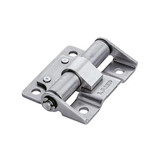
Sugatsune America's HG-JHM11-2BL damper hinge integrates that function into a compact hinge for inset lids, office equipment covers, and similar top-opening applications. To select the optimal specification, designers and engineers should carefully evaluate damping mechanics, rated torque thresholds, and mounting geometry.
A basic hinge establishes an axis of rotation. Without secondary damping components, gravity, human interaction, and baseline friction dictate how fast a lid slams shut. An integrated damper introduces resistance to that movement, helping the panel approach its closed position more gradually.
This distinction matters most for panels that are lifted frequently in upscale environments. , A controlled closing action can reduce the abrupt contact associated with free-swinging lids. With a single damping hinge, designers and engineers can add smooth motion without dedicating extra space to external dampers.
A damping hinge is not necessarily a positioning hinge, however. While friction and torque hinges are engineered to hold panels open at arbitrary angles, this hardware is tailored to govern closing speed. The HG-JHM11-2BL is designed primarily to regulate closing movement, not to provide an adjustable free-stop function.
Similarly, the terms soft-close hinge and slow-close hinge describe the desired behavior, but they do not automatically imply self-closing or self-locking operation. In practice, choosing an HG-JHM11-2BL still requires a separate physical catch or latch to secure the cover fully.
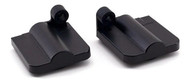
Sugatsune supplies the HG-JHM11-2BL as a matched left/right pair. The 105° hinges have a damping range of 0.89 ~ 1.77 lbs-in (1.02–2.04 kgf·cm) per pair.. The range is adjustable to ensure the appropriate closing speed and damping for your application.
Note that while fasteners are necessary for installation, they must be sourced separately. The product listing also identifies RoHS 3 compliance for this model. These specifications make the HG-JHM11-2BL worth evaluating where a panel must open predictably without a separate, externally mounted damping component. However, final suitability always hinges on lid dimensions, duty cycles, and environmental factors.
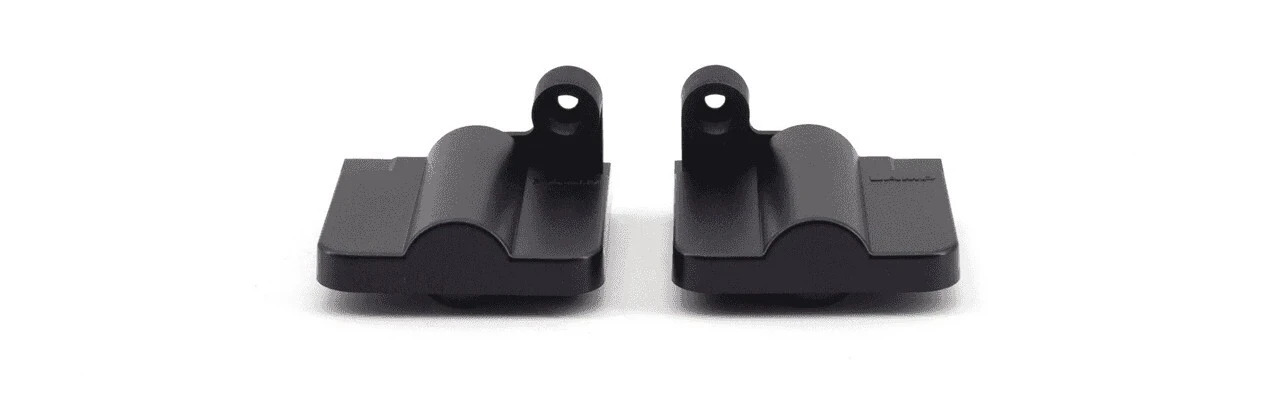
Correct installation matters as much as nominal torque. Because the HG-JHM11-2BL utilizes dedicated left and right components for inset side mounting, maintaining precise shaft alignment is essential to prevent binding.
Keep the shafts aligned to prevent binding and uneven motion. Before machining enclosures, verify all router recess profiles, mounting-hole alignments, material thicknesses, and operational clearances. Sugatsune's example installation illustrates a 16 mm lid and specifies at least 1 mm of opening clearance. Engineers should cross-reference these guidelines directly with project blueprints rather than unthinkingly copying sample dimensions.
For an alternative surface-mounted arrangement, Sugatsune identifies the optional UKZ11-BL mounting bracket, purchased separately. Selecting a different mounting bracket will change both the hardware layout and routing requirements.
Review the relevant drawings using Sugatsune's CAD file resources and the product's installation documentation. Internal fluid resistance kicks in only after the panel is lifted to roughly 60° or higher. Releasing a lid from a smaller opening angle may therefore produce a different closing response.
Applications must also respect the 105° maximum swing, as over-rotating the cover risks damaging the internal mechanism. Finally, use a separate stopper or appropriate latching mechanism to keep the lid closed. While a soft-close hinge controls descent speed, it doesn't act as a mechanical lock.
Small access lids on machine housings benefit from predictable motion during routine checks. Using a slow-close hinge helps dampen jarring impacts, provided the machinery is indoors and the panel weight stays within rated limits.
Desktop power compartments, cable-management covers, and recessed service openings often have limited room for motion-control hardware. An integrated solution saves space compared to installing bulky external damping shocks. Designers must still provide adequate space for cables and the full opening path.
Compact instrument housings and workbench compartments may call for quiet, controlled access. Snapping on the included screw covers creates a streamlined aesthetic while preserving the inset layout.
Damping does not replace sealing, electrical protection, or any application-specific safety evaluation. Across these uses, consider soft motion as part of the overall equipment design, alongside access clearance, lid retention, and operator requirements.
An integrated damper can reduce the number of components that need space inside an enclosure. For tight layouts, this minimizes internal hardware clutter around wiring conduits, mounting hardware, and service ports.
However, combining the hinge and damper also ties motion-control placement to the hinge axis. Shifting this pivot point alters both the panel's rotational arc and its center of gravity.
A separate damper may offer a different mounting position or an adjustable response, depending on its design, but it requires additional attachment points and clearance. Design teams should evaluate the total assembly footprint rather than relying solely on the soft-motion label.
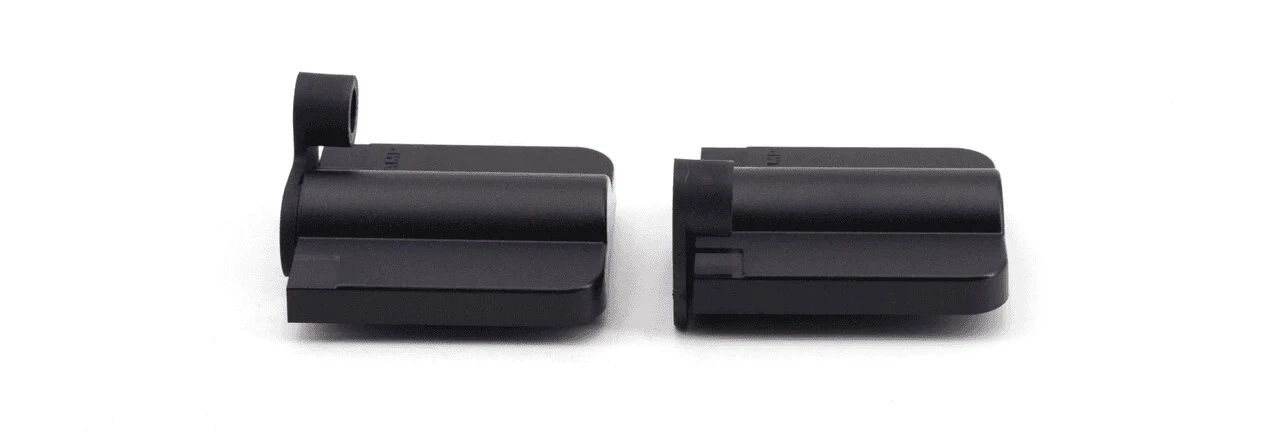
The HG-JHM11 series offers different damping ranges. For lighter applications, the HG-JHM11-1BL provides a lower resistance range of 0.44 ~ 0.89 lbs-in (0.51–1.02 kgf·cm) per pair. The HG-JHM11-3BL covers 1.77 ~ 2.57 lbs-in (2.04–2.96 kgf·cm), while the HG-JHM11-4BL covers 2.57 ~ 3.54 lbs-in (2.96–4.08 kgf·cm).
For a white aesthetic, the HG-JHM11-2WT delivers the same torque limits in an alternate colorway. Confirm each model's specifications and mounting requirements before substitution. If your assembly instead needs a hinge that holds position or a different damper configuration, review Sugatsune's hinges and torque dampers.
Selecting the right product ultimately depends on whether your project demands mechanical positioning, controlled damping, or a combination of both.
The HG-JHM11 series is specified for indoor, dry use at 32 - 104°F ( 0–40°C). Because internal fluid viscosity fluctuates with ambient temperature, closing speeds tend to accelerate in warm settings and slow down in cold environments.
For that reason, test the assembled lid across its anticipated operating conditions rather than judging performance at a single room temperature. Use production-grade panel materials, final hardware, edge seals, and internal components for all testing.
Observe closing from full and partial opening positions, verify hinge alignment, and check that the panel reaches its stop without interference. Because the HG-JHM11-2BL lacks manual adjustment screws, you must resolve unsuitable closing behavior by switching models or altering panel geometry.
Don't assume damping alone makes an enclosure suitable for outdoor exposure, high-duty-cycle operation, or safety-critical access.
The HG-JHM11-2BL combines a compact inset-hinge configuration with integrated closing resistance. Its real benefit comes from pairing precise damping calculations with a well-engineered enclosure, not treating it as a simple drop-in replacement.
Review the HG-JHM11-2BL specifications and downloadable drawings, or contact Sugatsune America to discuss lid moment, mounting constraints, and component selection with an industrial hardware specialist.
CAD files are available on each product’s detail page. Click the “CAD/BIM Files” tab, located in the middle of the page to download the different formats. If CAD files are not available for a specific component, please contact our Support Team
Toll Free: (800) 562-5267 (U.S.A. only)