Free Stop Motion with Sugatsune's Adjustable One-Way Torque Hinge (HG-TQJ100-B)
Posted On Oct 7th 2026
Posted On Oct 7th 2026
Posted On Oct 7th 2026
A hinged panel on industrial equipment does more than open and close. Instead of letting doors flop open or slam shut, modern designs often require targeted resistance, effortless lifting, or position retention at custom angles. Free stop motion provides this convenience by using friction within a torque hinge to hold a lid, door, or panel where the operator leaves it, rather than requiring the operator to hold it in place or rely on predetermined detent positions.
Sugatsune’s HG-TQJ100-B takes that concept further by combining free-stop positioning with adjustable, one-directional torque. By delivering continuous friction purely upon closure, the HG-TQJ100-B Adjustable One Way Torque Hinge ensures fluid, effortless operation when swinging upward or outward.
Its torque adjusts from 0 to 10 N·m, allowing engineers to tune resistance to the characteristics of a specific door, lid, panel, or equipment assembly.
Free stop motion is one of 6 Motion Design Tec® motions that uses friction to allow a component to stay in a selected position without a conventional mechanical stopper. Inside the hinge, various mechanisms cancel out gravity and rotational forces acting on the panel.
When the hinge supplies sufficient resistance, a lid or panel can stop at an intermediate angle rather than falling, swinging freely, or moving to a fixed detent. This makes free-stop hardware fundamentally different from a standard hinge. Standard pin hinges serve only as rotational pivots and offer no inherent holding power or movement braking.
Detent hardware, meanwhile, holds at specific predetermined positions. A free stop hinge, by contrast, provides continuously variable positioning within its specified operating range. By simply releasing the panel anywhere along its path, the user relies on continuous friction to hold the assembly motionless.
For equipment designers, this can reduce the need for separate lid stays, props, or positioning hardware. Eliminating secondary supports streamlines cabinet designs and gives operators complete freedom over screen or panel angles.
A conventional torque hinge can create resistance in both directions. While symmetrical holding force works well for balanced doors, forcing an operator to push against heavy resistance during both opening and closing cycles can lead to user fatigue.
An adjustable one-way torque hinge applies resistance primarily in one direction. Engineered as directional solutions, Sugatsune’s HG-TQJ100 series offers Type A for opening-direction friction and Type B for closing-direction friction. The HG-TQJ100-B therefore allows easier movement while opening and provides the controlled friction required for positioning as the panel moves in the closing direction. This directional behavior can be useful when equipment geometry or gravity already assists one part of the motion.
Instead of over-engineering the hinge with constant bidirectional drag, designers can focus resistance exactly where motion needs control. Sugatsune explains the broader engineering principles behind these mechanisms in its Torque Hinge Technology guide, which covers how friction at the hinge axis creates free-stop positioning.
The HG-TQJ100-B is also an adjustable friction hinge, allowing you to change the required resistance rather than forcing engineers to design around a single fixed torque value. This integrated adjustment mechanism tunes holding force from 0 to 10 N·m (up to 88.7 lb-in or 102 kgf-cm).
That adjustability matters because torque-hinge selection depends on more than the panel's weight. Total rotational moment depends heavily on panel depth, mass distribution, center of gravity, and installation plane.
Two panels of equal weight can create different moments if their centers of gravity are positioned at different distances from the pivot point. An adjustable hinge gives engineering teams additional flexibility during prototyping and commissioning.
Adding secondary accessories, heavy handles, or external control pads during design iterations directly impacts the required holding torque. Within the hinge’s specified adjustment range, you can tune torque to match the finished assembly better.
Sugatsune’s guide to calculating torque for friction hinges provides additional detail on evaluating panel moment before selecting position-control hardware.
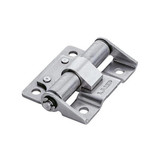
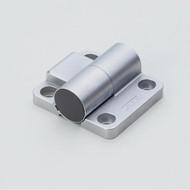
Beyond its motion characteristics, the HG-TQJ100-B has compact dimensions for incorporation into industrial assemblies. Made from high-grade zinc alloy, the 242 g hinge measures 60 mm (2.375 in.) wide by 55 mm (2.1875 in.) high, with a mounting pitch of 42mm (1.625 in.) for M5 or #10 self-tapping fasteners.
The HG-TQJ100-B provides a maximum opening angle of 180 degrees, is RoHS 2 compliant, and has passed a private 20,000-cycle open-and-close test.
Position control can be valuable anywhere a hinged component needs to remain accessible without swinging freely. Machine or equipment access panels are a clear example of this functionality.
An operator performing setup, adjustment, inspection, or maintenance may need a panel to remain partially or fully open while preserving access to components behind it. Free-stop positioning can also be applied to control panels, displays, medical equipment, office automation equipment, workstations, and other hinged assemblies.
Broadly versatile, the HG-TQJ100 series excels in factory automation cells, medical diagnostic equipment, , and manufacturing machinery. The one-way design is especially useful when the engineer requires low opening effort but controlled closing resistance.
By decoupling opening effort from closing resistance, the hardware feels lighter while preventing harsh drop-down impacts. That difference can affect more than user feel. Targeted motion dynamics protect delicate electronics, eliminate clunky gas springs or props, and deliver a cleaner structural layout.
Engineers should distinguish free-stop torque control from detent-based motion before selecting a hinge. Detent mechanisms are preferred when an access door only needs to lock into fixed, pre-set operational angles (such as 90° or 180°).
The operator moves through distinct positions, with the mechanism engaging at each designated stop. Free-stop positioning is preferable when the required angle may change from one use case or operator to another. Instead of locking into rigid factory steps, friction positioning allows infinite customization to suit varying operator heights and task angles.
Torque positioning is a friction-based resistance that holds a component at a selected position without a separate stay or stopper. Neither method is inherently better; they solve different engineering problems.
Detent hardware fits fixed-step access covers, while free-stop mechanisms cater to variable touchscreens and adaptable guard panels.
Selecting a torque hinge solely by maximum torque rating can produce poor results. Designers must analyze whether torque should resist gravity, dampen downward drops, or counteract external user pressure. With the HG-TQJ100-B, friction torque acts in the closing direction.
Unlike its counterpart, the HG-TQJ100-A, which restricts opening movement, this model ensures free upward lifting with controlled downward descent. Selecting between the two requires understanding how the panel is oriented and how gravity, user input, and equipment geometry affect its movement. Excessive torque is not automatically advantageous.
Over-specifying torque forces users to wrestle with stiff covers, while under-specifying leads to sagging and drift. Sugatsune recommends evaluating the completed panel moment and selecting hardware with an appropriate holding margin rather than simply choosing the highest available torque rating.
For more background on friction-hinge selection, Sugatsune’s How to Specify Friction Hinges guide discusses torque tolerance and door moment in positioning applications.
The value of free-stop motion is ultimately its ability to make motion itself part of the equipment design. Hardware selection expands beyond simple structural attachment to an active design parameter that governs user ergonomics and safety.
With adjustable torque from 0 to 10 N·m, closing-direction friction, a 180-degree maximum opening angle, and durability tested for 200,000 cycles, the HG-TQJ100-B gives engineers a reliable solution for industrial panels that require both positioning and easier movement in the opposing direction.
Sugatsune America develops precision-engineered hardware for industrial equipment, machinery, vehicles, aerospace applications, office furniture, and specialized facilities, with technical content intended to help project engineers evaluate hardware against application requirements.
When panel geometry, center of gravity, torque requirements, or mounting conditions make specification more complex, contact Sugatsune America to discuss the engineering challenge with Inside Sales.
For custom installations or complex mass distributions, technical support specialists can help verify hinge moments and mounting parameters.
CAD files are available on each product’s detail page. Click the “CAD/BIM Files” tab, located in the middle of the page to download the different formats. If CAD files are not available for a specific component, please contact our Support Team
Toll Free: (800) 562-5267 (U.S.A. only)