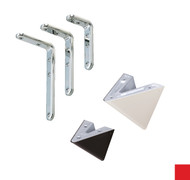
Brackets
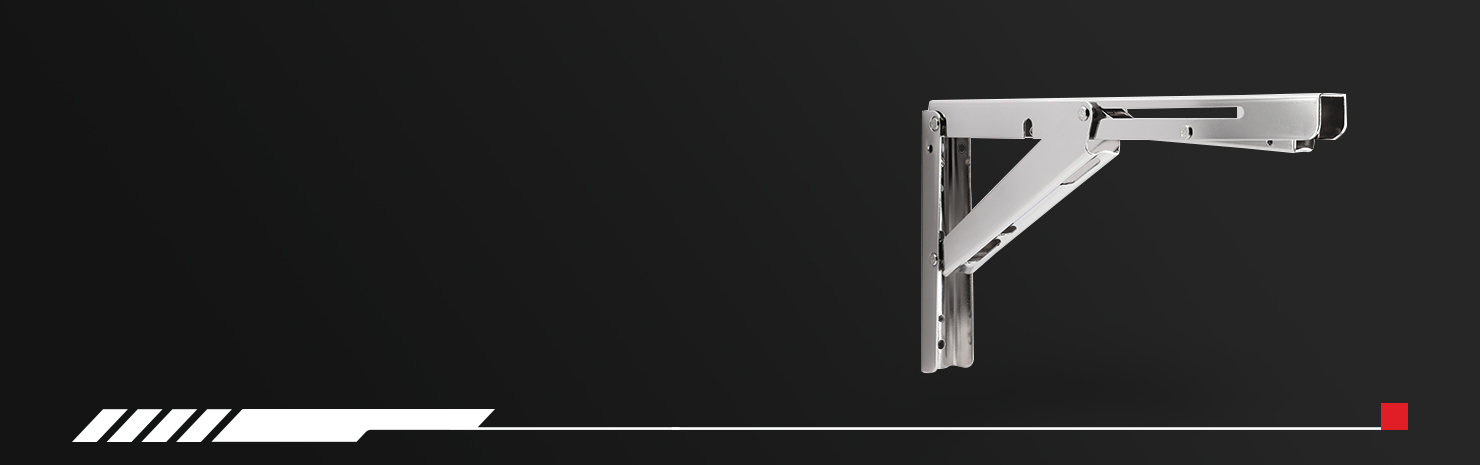
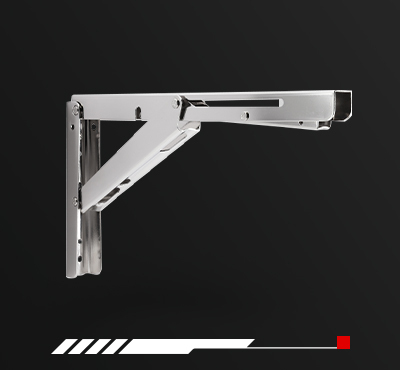
This catalog includes shelf brackets, folding shelf brackets, and Shelving brackets designed for use in cabinetry, millwork, commercial interiors, and industrial environments. Built from high-quality materials, including corrosion-resistant stainless steel, these solutions support a wide range of load requirements and installation conditions.
For assistance selecting the appropriate brackets and shelf supports, contact our team to match load, mounting, and application requirements.
Certified Load Capacity
Ships in 24 Hours
Meets ANSI Standards
Subcategories

Engineered for Load Performance and Installation Reliability
Sugatsune brackets and shelf supports are designed to provide consistent load-bearing performance and long-term durability.
Key engineering considerations include:
- Load capacity per bracket and per pair
- Mounting method and anchoring surface (e.g., wall studs, panels, structural backing)
- Material selection, including stainless steel for corrosive or sanitary environments
- Bracket geometry and load distribution
- Cycle durability for folding and moving components
Many shelf brackets are designed for fixed installations requiring maximum rigidity, while folding shelf brackets incorporate integrated hinge mechanisms for controlled movement and space-saving functionality.
Key Performance Considerations for Brackets and Shelf Supports
When specifying bracket and shelf support hardware, consider:
- Required load capacity and safety factor
- Shelf depth and bracket spacing
- Material compatibility (wood, glass, metal shelving)
- Fixed vs folding functionality
- Environmental conditions (moisture, corrosion, sanitation requirements)
- Ease of installation and maintenance
The following comparison outlines common bracket types and their typical applications:
|
Type |
Best For |
Key Benefit |
Consideration |
|
Fixed Shelf Brackets |
Permanent shelving, heavy loads |
Maximum strength and stability |
No adjustability after installation |
|
Folding Shelf Brackets |
Space-saving applications |
Collapsible design for flexibility |
Requires proper load rating selection |
|
Stainless Steel Shelf Brackets |
Food service, medical environments |
Corrosion resistance, NSF options |
Higher material cost |
|
Angle & Corner Brackets |
Structural reinforcement |
Simple, rigid support |
Limited flexibility |
|
Adjustable Shelf Hinge Hardware |
Flexible layouts |
Repositionable shelving |
Lower load capacity than fixed brackets |
Application Versatility Across Architectural and Industrial Environments
Sugatsune brackets and shelf supports are specified across a wide range of applications where load capacity, space optimization, and durability are critical:
- Commercial shelving and retail displays
- Industrial storage and utility systems
- Residential and architectural millwork
- Food service and medical environments requiring stainless steel hardware
- Compact or multi-use spaces utilizing folding shelf brackets for space-saving shelf supports
Folding shelf brackets are particularly effective in applications where surfaces must be deployed when needed and stored when not in use, improving flexibility in constrained environments.
Designed for Strength, Flexibility, and Clean Integration
From an architectural perspective, brackets and shelf supports must integrate cleanly into the overall design while maintaining structural integrity.
- Fixed brackets provide a minimal, stable solution for permanent installations
- Folding shelf brackets support adaptable spaces without compromising load capacity
- Stainless steel options offer both durability and a clean, modern appearance
From an engineering standpoint, proper selection ensures load distribution, secure anchoring, and long-term performance.
FAQs
What are the benefits of folding shelf brackets?
Folding shelf brackets provide space-saving functionality by allowing shelves to collapse when not in use. Many models are engineered for high load capacity, with select options supporting 600+ lbs per pair, while also offering corrosion resistance and NSF-certified designs for commercial environments.
When should fixed shelf brackets be used instead of adjustable shelf hinge hardware?
Fixed shelf brackets are preferred for applications requiring maximum strength and stability, particularly for heavy loads. Adjustable shelf hinge hardware offers flexibility but typically does not match the load capacity of fixed installations.
What are the best options for space-saving shelf supports?
Folding shelf brackets are the most effective solution for space-saving applications. They allow surfaces to be deployed when needed and folded away when not in use, making them ideal for compact residential, commercial, and industrial environments.
