Sugatsune’s HES Concealed Hinges: Tuned to Perfection
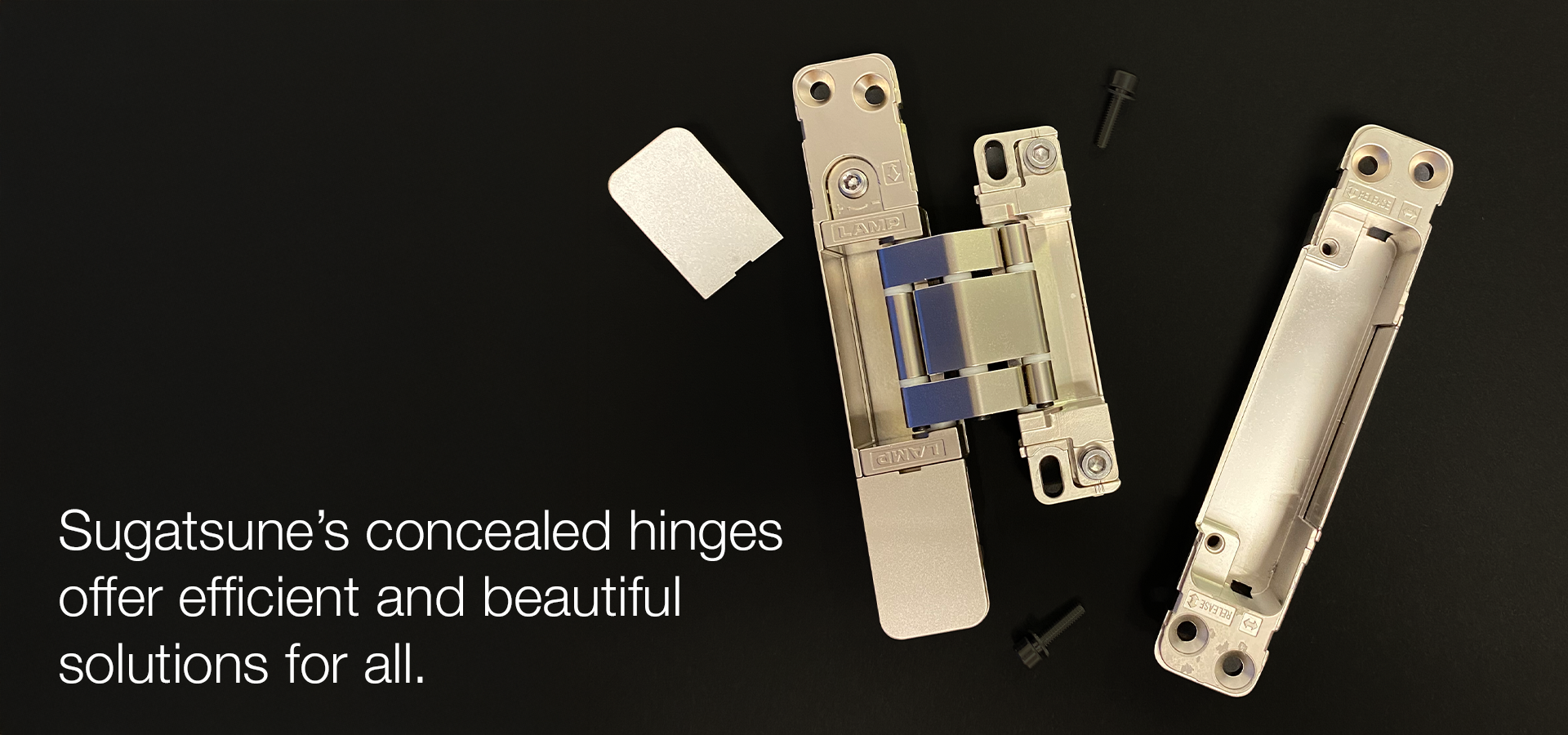
The concealed hinge offers a practical solution to problems that are commonly faced by professional contractors and homebuilders alike. When combined with hidden doors or cabinets, these products bring a refined minimalist aesthetic within reach and add a touch of disguise to the modern home. Sugatsune’s HES Concealed Hinges, with three-dimensional adjustability, ensure an even reveal so that the architects’ vision harmoniously, comes to life.
Introduction
As small architectural components with larger metaphoric implications go, it is hard to find one more useful and meaningful than the humble hinge. A few ounces of metal can support hundreds of pounds of weight in motion, and as a result, design ideas that generate some of an architect’s most dramatic effects: transitions between spaces. A hinge is a simple piece of hardware on which a great deal of creativity can pivot.
The global firm Sugatsune, founded in Tokyo in 1930 and now established on six continents, has built a reputation for hinges and other components that architects and builders rely on for durability, refined aesthetics, and ease of installation. The HES Hinge series in particular takes the concept of the concealed hinge and optimizes its adjustability, expanding its possible applications beyond the luxury sector and bringing elements of elegance and surprise to a wider range of building types.
Refining and Expanding
Concealed hinges have numerous advantages over traditional butt hinges, including greater durability, as their moving parts are protected from the elements, as well as cleaner visual lines. They can even contribute to a building’s security, since the exposed pins of a butt hinge can be vulnerable to intruders and removable with simple tools: A concealed hinge gives a wrongdoer no accessible hardware.
The German manufacturer Soss deserves the credit for the invention of the concealed hinge in the early 1900s. The Soss hinge is popularly used product, said Fernando Vargas, Creative Director for Sugatsune America. However, it is more difficult to install because it lacks any adjustments, so mortising it into the door and frame has to be precise. His solution? “Ours.”
In 1992 Sugatsune introduced the adjustable concealed hinge, the HES series (for “Hinge + Esprit,” named by Sugatsune’s Tokyo office), which features adjustment in three dimensions. You can move the door vertically and horizontally as well as forward and back to ensure perfect flushness and an even reveal.
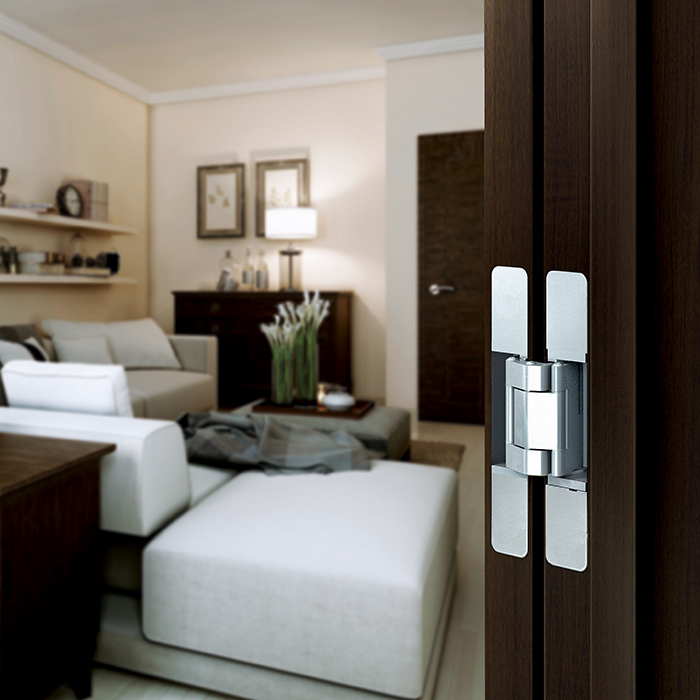
The customer base for HES hinges comprises both design/construction professionals and do-it-yourselfers, said Michael S., luxury sales consultant at Kurrent (one of many Sugatsune distributors in New York). He estimates that “it’s divided, with an even 40 percent contractors, 40 percent architects, and then 20 percent DIYers.” Sugatsune provides jigs for easy installation with a DIY-level router, but for contractors using more sophisticated equipment, the San Francisco–based firm Shaper Tools (suppliers of the world’s first computer vision, hand-held CNC router, the Origin) provides specific pre-loaded digital templates for Sugatsune HES hinges.
As either professional carpenters or builders can attest, doors can require incremental realignment once they are installed in a doorframe. The adjustable Sugatsune HES hinges allow this fine-tuning even if bearing weight and with relative ease, both at the initial installation and for later adjustments if needed, simply by loosening and tightening of the three adjustment screws to position the door precisely. It is usually “more of a one-time, set-it-and-forget-it” operation, Vargas said, resembling tuning a piano (an infrequent operation) rather than tuning a guitar (necessary every time a player picks it up). “In our world of fast use and throwaway materials,” he added, “our hinge is built to last. You put it on once, and you will likely never have to change it.”
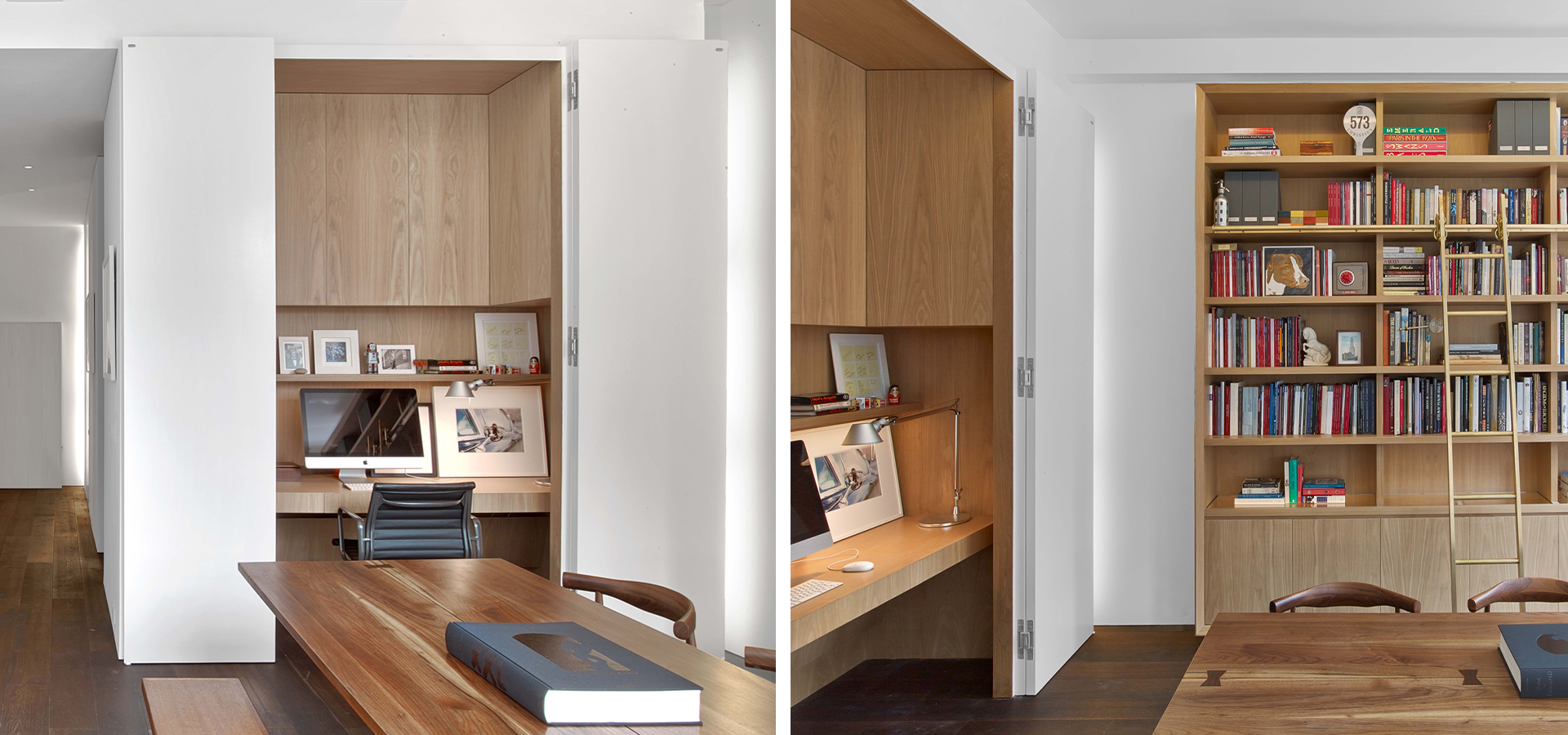
The combination of concealed hinges and hidden doors is particularly appealing to many of today’s clients, who enjoy the moment when they can reveal an unexpected space to guests through a barely perceptible threshold. With HES hinges, Vargas explained that “you can create a nice clean minimalistic finish, but it can also create a completely hidden door. Instead of a handle, you can put in a push-to-open latch and have a hidden door in the middle of your house.” An entrance to another room that appears invisible at first glance, he added, can “create that wow factor” for visitors. Another potential application resembles the special high-security feature popularized in the classic 2002 home-invasion thriller Panic Room directed by David Fincher: a Manhattan residence includes a secret fortified chamber containing a safe and survival provisions, accessible only by a push-to-open wall panel and noticeable only to the most careful observer.
Relatively few residents in the noncinematic world dedicate space to intruder-proof rooms, though Vargas has found that “more and more architects and designers are specifying a concealed hinge or hidden door.” Rob Suri, owner of the Manhattan hardware manufacturer and distributor Hamilton Sinkler, includes his own firm’s offices among projects with hidden employees-only spaces. “Those rooms lead on from public spaces, where clients are coming into a showroom; then the door opens and there’s a room inside, but no one knows there’s a room behind those panels, purely because of those concealed hinges. That’s the predominant leading factor as to using the concealed hinge. You don’t want to have the hardware noticeable; you want it to be able to meet the load requirements of the door; you need the adjustability; you need it to be installed fairly easily; you need to be able to adapt to fire code applications if required; and you need the affordability factor as well.” Sugatsune’s HES, Suri said, checks all these boxes and “hits the project’s budget easily over any other hinge that’s in the market.”
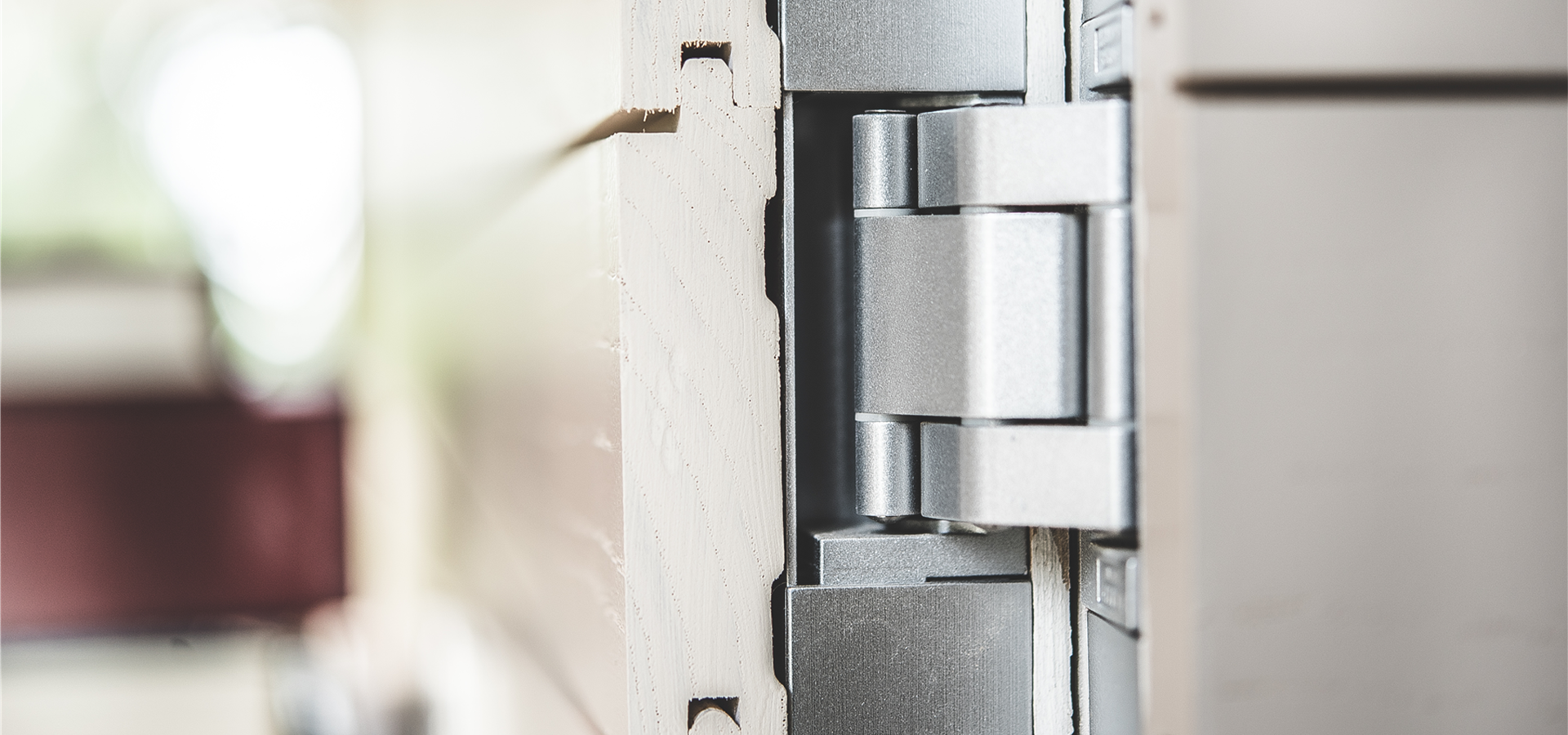
The range of applications is wide, and Sugatsune offers five sizes of HES hinges with different load capacities. Hinges with a wider throw (the arm dimension) accommodate doors with cladding or paneling. Materials include zinc alloy and stainless-steel, with the latter being recently launched in 304-Grade allowing outdoor applications. Plastic internal pieces prevent metal-to-metal contact during movement and require no lubrication; finishes include black, dull chrome, dull nickel, polished nickel, and polished chrome.
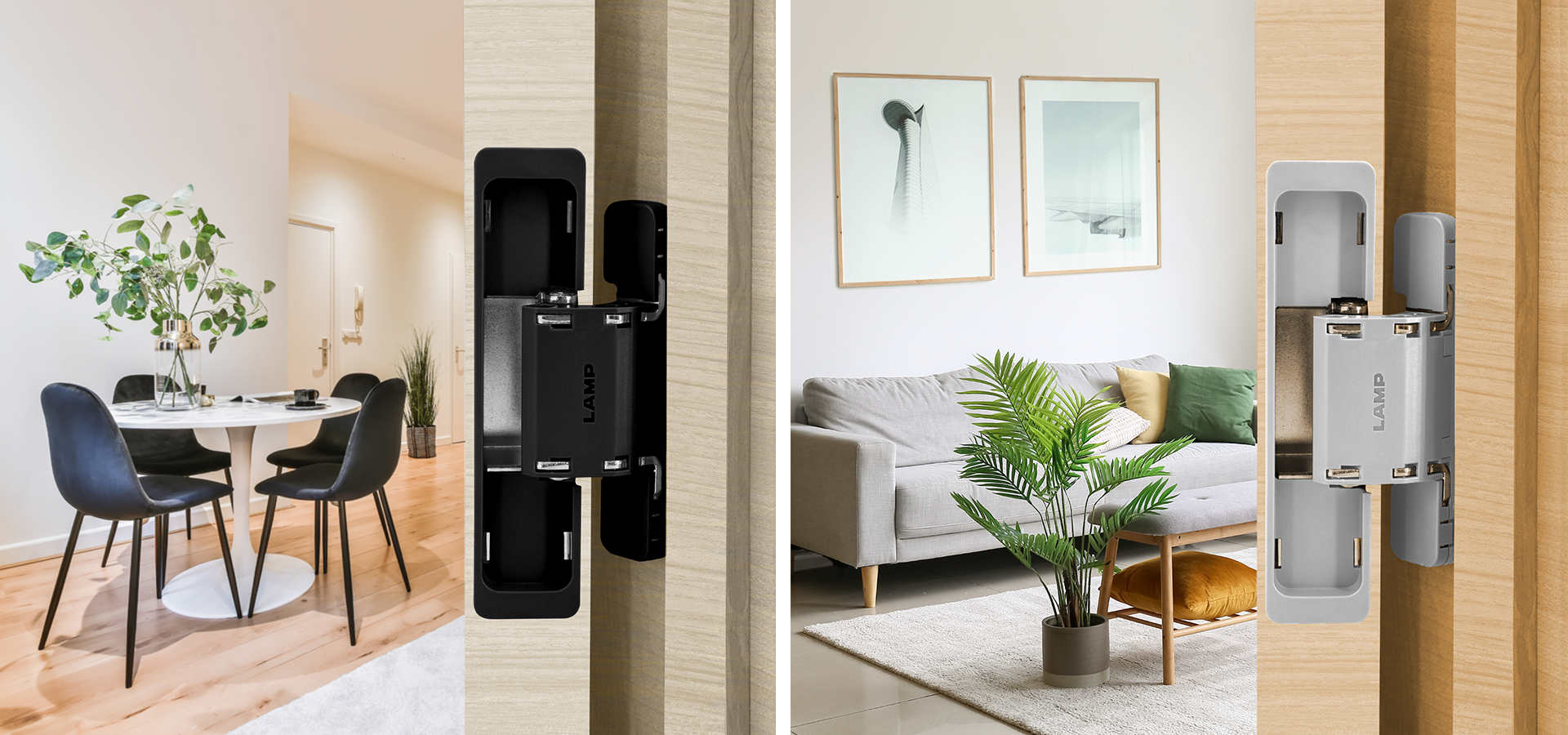
HES2S
The HES2S model, introduced at the International Builders Show in 2023, makes installation even easier. It is the world’s first surface-mounted concealed hinge mounted to the door frame, which Vargas described as customarily the more difficult and unforgiving site for routing. Routing for an HES2S is limited to the door; on the frame side, there is “no routing necessary. We screw it right on; you put in the four screws, and now you can just swing your door.” The HES2S has been a game-changer, making Sugatsune adjustable hinges an option for those that want to create a sleek, modern reveal for their doors. “It’s almost like we’re bringing hidden doors to the masses,” said Vargas. “We want to make it easier for more people to enjoy a hidden door.”
In the Media
Brooke and Brice Gilliam of Nashville, who have parlayed their own home-renovation skills into a design-build business that attracted the attention of cable television’s Magnolia Network, are among the professionals who choose Sugatsune hinges for their precision and adaptability. What began as a sideline alongside their full-time professions (Brice is an orthodontist as well as a designer, and Brooke works in pharmaceutical sales) has blossomed into national recognition through their series Making Modern with Brooke and Brice. The Gilliams got into the residential renovation business almost by accident, after a less-than-satisfying project in their own home awakened their DIY instincts.
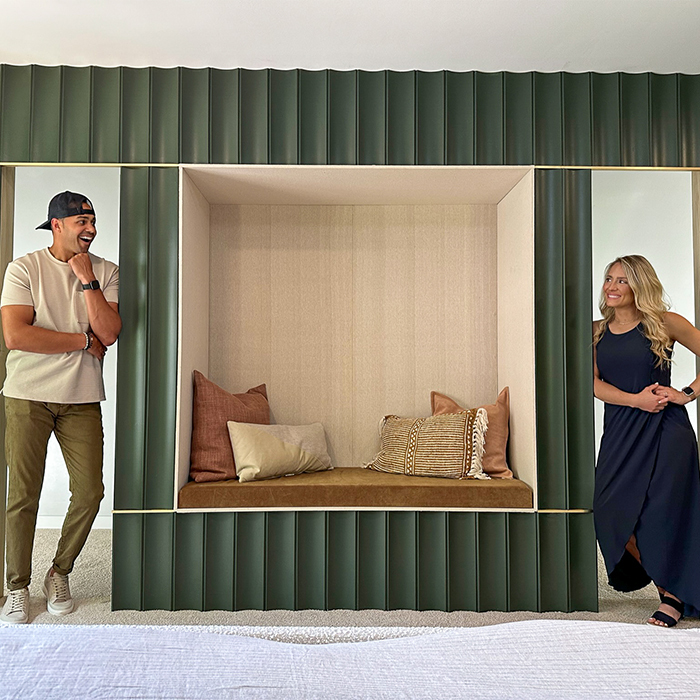
“We didn’t have an extremely pleasant experience with our general contractor,” Brooke Gilliam recalls, who “kind of came with the land when we bought it, and so we ended up taking the project into our own hands and finishing things. I learned how to use power tools from the subcontractors that were here working. They’d teach me how to use them, leave their tools, and let me practice and play around.” Friends and family noticed the quality of the Gilliams’s work and began asking for their assistance on local projects. It wasn’t long before the synergy between Brice’s design skills and Brooke’s growing experience as a builder caught the eye of a neighbor who connected them with a former Good Morning America staffer, who suggested they could have their own show. A pilot episode and three full seasons later, Brooke is now a licensed general contractor, and the couple’s high-energy conversational style has struck audiences as “infectious.” Their aesthetic, which Brice called “functional modern,” is becoming increasingly popular as an alternative to the homebuilding traditions of the Nashville area.
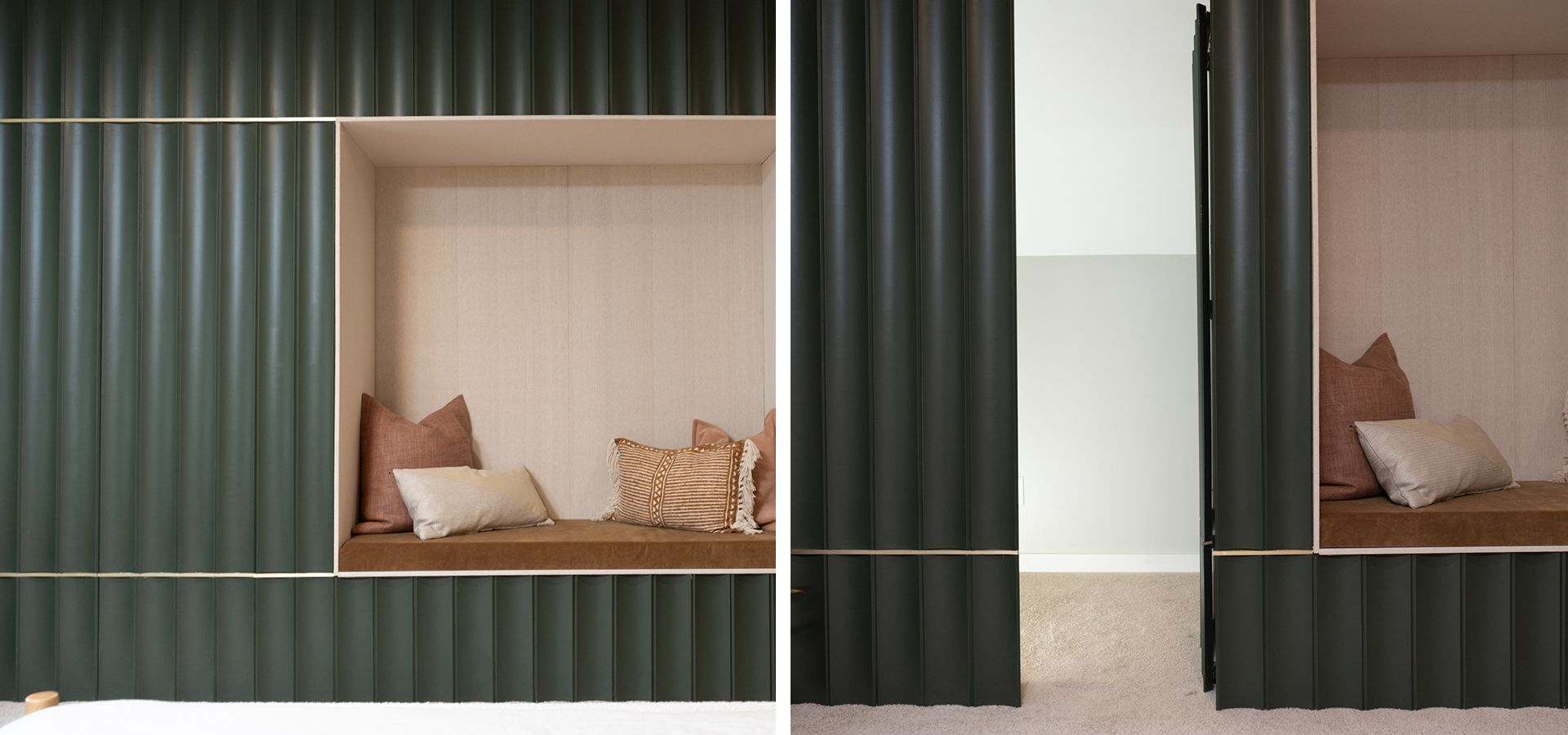
They have found Sugatsune’s adjustable hinges indispensable throughout their new career. On “almost every single project” since Making Modern began, Brice said they’ve used the HES series. “We’d always wanted to use these hinges,” Brooke added, “but we hadn’t had that opportunity” until the clients on the pilot episode presented the team with a challenging detail: an unwanted pony wall in a bedroom to be closed off and replaced with a door to a bathroom. Brice’s suggestion was to ask, “What if we build a door here that’s going to be hidden and built into the design, where nobody even knows it’s there until it’s pushed?” With Sugatsune’s recessed hinges, the new handle-less door essentially disappears from view. “The homeowners loved it,” Brooke reported.
Typically, the program films client reactions when the Gilliams reveal each detail of a project. “As soon as the cameras stop,” Brooke continued, “clients ask, ‘Can we go and look at the door again?’ or ‘Can we install these on all of our doors?’ They want to know how it works.” A Sugatsune-hinged hidden door on the Gilliams’s own bedroom elicits similar responses: “Every time any guest sees it there, they have no words; their jaw hits the floor. You cannot tell there’s a door there.”
“Unexpected doors or hidden doors give you this feel of being a kid again,” Brice added. “Your imagination gets to run wild. It’s kind of whimsical, but then, if you use hardware like this, it’s sophisticated and luxurious as well. So, you’re getting this fun and playful vibe of having a hidden door or unexpected experience, but then you mix that with such a classy and precise hinge that it’s awesome.”
Centering Reuse
Most of the Gilliams’s projects—the 70 percent that are featured on the show and the 30 percent outside it—are renovations. They have only recently started two ground-up projects, which they describe as much easier than working with existing houses. “As often as I can reuse things within a home, I try to,” Brice said. “But it’s not always possible. Sometimes the building materials are subpar, or there’s water damage. Whatever it is, whenever we can, we like to reuse them. And that’s what’s really cool about the Sugatsune hinges: Because we do the custom work we do, we can make something work and fit, and not have to just pitch it and start fresh.”
A typical challenge, Brooke said, appears when they install a new hidden door in an old wall: “If we’re going all the way to the ceiling so that you don’t have a horizontal break in the door line, we’re having to go into attic spaces and add headers and extra beams in order to support the wall, to make a door go all the way up to the ceiling, versus just a 6- or 8-foot door.” The natural settling of any older building and the seasonal swelling and contraction of wood in Tennessee’s warm climate, combined with work performed by multiple contractors over the years, can leave a house with wavy walls and out-of-plumb door frames. “Even when you take it down to the studs,” said Brice, “it still makes it challenging, because you’re still working within the context of that space.” The three-dimensional adjustability of Sugatsune’s HES hinges allows fine-tuning to compensate for such anomalies. “I can’t overstate it,” he continued: “The ability to make these micro-adjustments just by popping off the concealed cover—you just take a little Allen wrench and adjust the door in and out, up and down, front to back—it’s just those little things that can make that door swing perfectly every single time.”
Brooke also admired how new Sugatsune hinges can help conserve valuable assets. “We can take apart the old door. If it’s a good-quality door, a solid door, then we’re able to get rid of the old jamb, put a new jamb in, and use their old door with these hinges. And then we can clad over it to make a beautiful focal wall, and we don’t have to go get a brand-new door.” This, as Brice noted, means saving waste materials: “We save a lot of those things that you would’ve just thrown away, that would end up in the landfill.” Renovating older houses and repurposing existing components are aspects of a design-build practice that takes a long-range view of both the built environment and its inhabitants. The Gilliams often encounter clients who have grown weary of their houses and are ready for changes; strategic changes in simple elements can make the difference between abandonment and reinvigoration.
Brooke summed up the impressions that her husband’s designs and Sugatsune’s hardware help create: “When we’re talking about doing a custom hidden door in their project or a door with concealed hinges, Brice always tells people that doors are inevitable; you have to use them in your home at all times. But to make every time you open a door an experience, it’s something that will help you love your home for a lot longer. Every time somebody is opening a door, it’s not just part of a normal act of the day. It’s something that means they get to say, ‘wow.’ And then every time they have family or friends over to their house, and they open that door, there’s this ‘wow’ moment where they get to experience it. It helps the homeowners fall back in love with their space.”
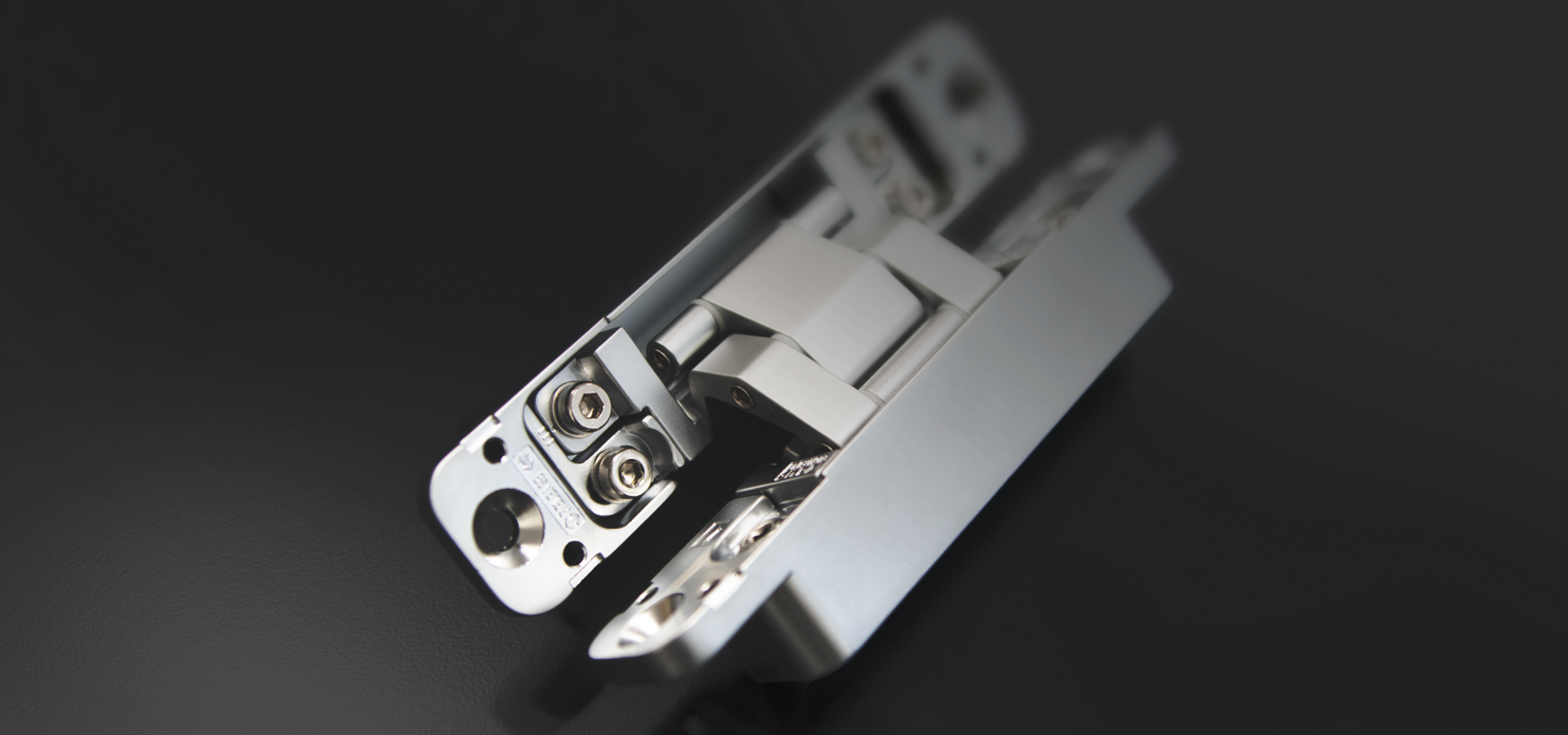
The three-dimensional adjustability of Sugatsune’s HES hinges allows fine-tuning to compensate for such anomalies. “I can’t overstate it,” he continued: “The ability to make these micro-adjustments just by popping off the concealed cover—you just take a little Allen wrench and adjust the door in and out, up and down, front to back—it’s just those little things that can make that door swing perfectly every single time.”
Brooke also admired how new Sugatsune hinges can help conserve valuable assets. “We can take apart the old door. If it’s a good-quality door, a solid door, then we’re able to get rid of the old jamb, put a new jamb in, and use their old door with these hinges. And then we can clad over it to make a beautiful focal wall, and we don’t have to go get a brand-new door.” This, as Brice noted, means saving waste materials: “We save a lot of those things that you would’ve just thrown away, that would end up in the landfill.” Renovating older houses and repurposing existing components are aspects of a design-build practice that takes a long-range view of both the built environment and its inhabitants. The Gilliams often encounter clients who have grown weary of their houses and are ready for changes; strategic changes in simple elements can make the difference between abandonment and reinvigoration.
Brooke summed up the impressions that her husband’s designs and Sugatsune’s hardware help create: “When we’re talking about doing a custom hidden door in their project or a door with concealed hinges, Brice always tells people that doors are inevitable; you have to use them in your home at all times. But to make every time you open a door an experience, it’s something that will help you love your home for a lot longer. Every time somebody is opening a door, it’s not just part of a normal act of the day. It’s something that means they get to say, ‘wow.’ And then every time they have family or friends over to their house, and they open that door, there’s this ‘wow’ moment where they get to experience it. It helps the homeowners fall back in love with their space.”
The Choice of High-Profile Architects
Sugatsune’s HES hinges are elegant, high-functioning components of projects involving rarefied clienteles and prominent architects. Hamilton Sinkler’s Suri noted that the renovation and condominium conversion at the Upper West Side’s landmarked Belnord building (Hiss & Weekes, 1908) posed challenges involving rigorous building codes.
Suri’s firm worked with Robert A. M. Stern Architects (RAMSA) to select hinges for both fire-rated and non-fire-rated applications with demanding weightbearing requirements.
“In New York City,” he said, “you need to use more hinges; even though the Sugatsune hinge is fire-rated for two hinges per door, the fire code supersedes anything that’s been approved,” requiring “three hinges on the door, minimum.”
Suri consulted Sugatsune’s technical department, who were very responsive:
“They provided me with the certifications. I coordinated with Underwriters Laboratories to reaffirm the information on their approvals. I was able to get it specified on that particular project, and we used thousands of those hinges, and it met the weight or capacity, it met the fire code, and it met the price as well.”
Replacing a different product originally specified, Sugatsune’s HES hinges “fulfilled not only the design aesthetic and aspects of the project, but also it met the developer’s challenges.”
Suri added that Sugatsune’s HES hinges are used in service units and model rooms at The Raleigh, a mixed-use hotel/ residential complex currently undergoing renovation and expansion by architect Peter Marino. When completed, the five-tower Raleigh will host that city’s most exclusive guests and residents, and Suri speculates that HES hinges are likely to be approved throughout the project.
Wherever visual subtlety is at a premium and quiet reliability is essential, the world’s doors open with Sugatsune.